
When you’re selecting a multistage centrifugal pump for your system, one question often comes up: Should I choose a Grundfos CR or a Grundfos CM?
At first glance, they may look similar. Both are high-quality multistage pumps from Grundfos. Both are reliable. Both are widely used in South Africa. However, they are designed for slightly different applications — and understanding that difference can save you money, energy, and future headaches.
Let’s break it down in simple terms.
Grundfos CR – The Vertical Multistage Workhorse


4
The Grundfos CR is a vertical multistage centrifugal pump. It is designed for higher pressures, higher flow ranges, and more demanding industrial or commercial applications.
Key Characteristics for Grundfos CR:
- Vertical design
- In-line suction and discharge
- High-pressure capability
- Modular construction
- Available in stainless steel versions (CRN)
- Suitable for larger systems
Where CR Pumps Are Typically Used:
- Commercial buildings
- High-rise pressure boosting
- Industrial process water
- Boiler feed systems
- Reverse osmosis systems
- HVAC circulation
Because of its vertical design, the CR pump takes up less floor space, which is ideal in plant rooms where space is limited.
It is also highly modular. That means you can customize materials, shaft seals, motors, and even add integrated VSDs (like Grundfos CRE versions).
Simply put:
If your application is demanding, continuous-duty, or industrial-grade — the CR is often the safer long-term choice.
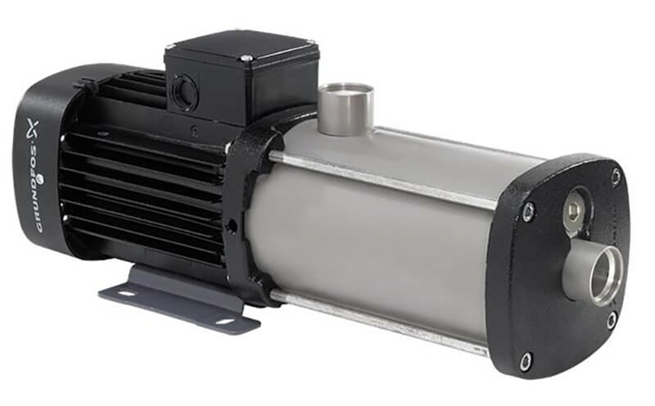
Grundfos CM – The Compact Horizontal Solution

4
The Grundfos CM is a horizontal multistage pump. It is compact, efficient, and designed primarily for light commercial and domestic applications.
Key Characteristics:
- Horizontal design
- Compact footprint
- Cost-effective
- Quiet operation
- Easy installation
- Suitable for moderate pressure needs
Where CM Pumps Are Typically Used:
- Domestic booster systems
- Small commercial buildings
- Water supply systems
- Light irrigation
- Water treatment units
The CM range is generally more affordable than the CR range. It works extremely well for homes, small businesses, and systems that don’t require very high pressure or extreme durability.
If your system is smaller and budget matters — the CM is often a smart solution.
Grundfos CR vs CM – Side-by-Side Comparison
| Feature | Grundfos CR | Grundfos CM |
|---|---|---|
| Design | Vertical | Horizontal |
| Pressure Capability | High | Moderate |
| Typical Application | Industrial / Commercial | Domestic / Light Commercial |
| Floor Space | Minimal footprint | Slightly more |
| Customization | Highly modular | Limited options |
| Cost | Higher | More affordable |
So, Which One Should You Choose?
Here’s a simple way to think about it:
- If you need high pressure, long operating hours, and maximum reliability, go with CR.
- If you need a compact, cost-effective solution for moderate pressure, go with CM.
However, pump selection should never be guesswork. Flow rate, total dynamic head (TDH), water quality, operating hours, and system design all play a role.
Choosing incorrectly can lead to:
- Over-sizing (wasted energy)
- Under-sizing (low pressure complaints)
- Premature seal failure
- High electricity costs
That’s why it’s important to match the pump to the duty point — not just the price.
Final Thoughts
Both the Grundfos CR and Grundfos CM are excellent multistage pumps. The difference is not about “better” or “worse.” It’s about application fit.
When you understand what each pump was designed to do, the decision becomes much clearer.
If you’re unsure, always start with:
- Required flow rate (m³/h)
- Total dynamic head (m)
- Operating hours per day
- Installation space limitations
Once those are clear, selecting between CR and CM becomes straightforward.